01. Observer
The system studies your codebase’s structure to build the contextual foundation its subsequent agency depends upon.
No agentic action is taken. The system is proving it understands your world before it presumes to act within it.
Engineering Intelligence for Effective Agentic Workflows.
Every module across your digital estate is measured, ranked, and contextualised.
Surfacing cost, value, and the ratio between them.
Updated in real-time with every commit to your main branch.
Enabling data-driven decisions for module lifecycle management.
Every level is a permission set you sign off. Earned on evidence, and revocable.
Much like onboarding a human engineer, Modo joins as an observer: studying your codebase, familiarising itself with your architecture. Human onboarding takes weeks. Modo learns in minutes.
The system studies your codebase’s structure to build the contextual foundation its subsequent agency depends upon.
No agentic action is taken. The system is proving it understands your world before it presumes to act within it.
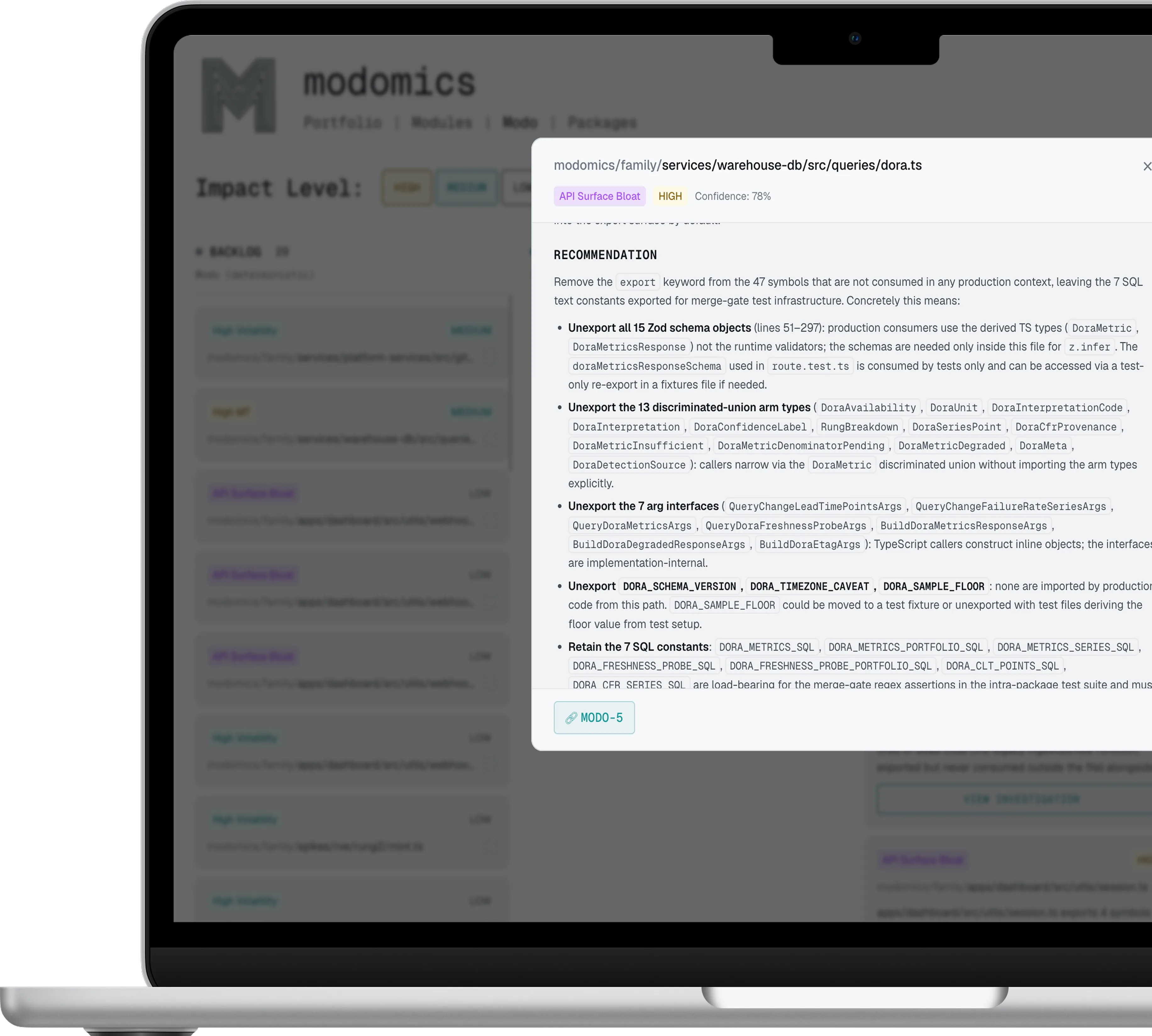
Modo surfaces recommendations; flagging modules with maintenance tax, identifying complexity outliers, proposing triage based on cost-to-value. Every recommendation is traceable to the objective measurement that produced it. Modo reasons and proposes; the team decides.
Modo investigates root causes, plans and proposes remediation paths, and opens pull requests. Each bounded to a specific task with clear acceptance criteria. Modo acts within human-defined boundaries; your team reviews and approves.
Strategic simulation capability; modelling remediation scenarios, projecting economic impact across quarters, participating in resource allocation decisions. Agency at this stage is earned through demonstrated competence and organisation-specific institutional knowledge that cannot be replicated.
On Day 1 your portfolio baseline is analysed and presented.
Everything after is measured against it.
A single authorisation step grants read-only access to selected repositories. No build system integration, no agent deployment. Operational in under five minutes.
Your codebase’s full economic history is mapped within your secure environment. Full codebase analysis surfacing structural complexity, temporal patterns, sibling-edges and churn hotspots.
Every module measured, ranked, and contextualised. Updated in real-time with every commit to your main branch. Modo’s first recommendations surface within 45 minutes.
Modomics exists to give you agency over your codebase, not to monitor the people who build them.
When Modo surfaces a high-cost module, the response is prioritisation and remediation; not a performance review.
The system measures modules, not engineers.
Modo leverages the institutional context from your digital estate to reason and propose.
If a recommendation doesn’t fit your context, it is discarded without consequence.
The System of Agency serves your engineering teams.
The system’s agency deepens with every revolution. Each cycle compounds understanding, sharpens measurement and earns trust for the next action.
Proprietary AST parsing + git archaeology map the structural and temporal reality of the codebase. This is observation, not interpretation: compiler-grade precision, with zero LLM involvement.
Maintenance Tax and Module Value Score are calculated across every module across your digital estate. Cost & value are quantified, creating the institutional context map that prioritises what matters.
Deterministic pattern recognition surfaces modules that warrant attention: high maintenance tax, complexity density outliers, stagnation indicators, dead-code candidates. The system raises what has not been noticed.
Modo investigates flagged modules with full context from your digital estate: root cause analysis, dependency impact mapping, remediation feasibility. Intelligence becomes understanding.
Modo proposes and executes remediation within human-defined boundaries. Every merged PR feeds back into the cycle; recalibrating measurement, sharpening insight, earning trust for the next action.
Learns the organisation's specific profile: team topology, ownership patterns, cultural nuances. Generic benchmarks become organisation-specific economics.
The system’s agency deepens with every revolution. Each cycle compounds understanding, sharpens measurement and earns trust for the next action.
Proprietary AST parsing + git archaeology map the structural and temporal reality of the codebase. This is observation, not interpretation: compiler-grade precision, with zero LLM involvement.
Maintenance Tax and Module Value Score are calculated across every module across your digital estate. Cost & value are quantified, creating the institutional context map that prioritises what matters.
Deterministic pattern recognition surfaces modules that warrant attention: high maintenance tax, complexity density outliers, stagnation indicators, dead-code candidates. The system raises what has not been noticed.
Modo investigates flagged modules with full context from your digital estate: root cause analysis, dependency impact mapping, remediation feasibility. Intelligence becomes understanding.
Modo proposes and executes remediation within human-defined boundaries. Every merged PR feeds back into the cycle; recalibrating measurement, sharpening insight, earning trust for the next action.
Learns the organisation's specific profile: team topology, ownership patterns, cultural nuances. Generic benchmarks become organisation-specific economics.